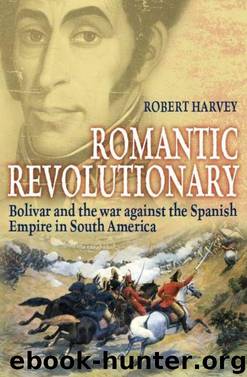
Bolivar by Robert Harvey
Author:Robert Harvey [Robert Harvey]
Language: eng
Format: epub
ISBN: 9781849018104
Publisher: Skyhorse Publishing, Inc.
Published: 2011-08-10T16:00:00+00:00
The Orinoco river is one of the greatest in a continent of great rivers. Not as wide or as long as the Amazon, it is still some 400 yards broad even as far upstream as Angostura, which indeed derives its name because it marks a narrowing. It wends its way over 1,500 miles from its source in Venezuela’s Roraima Plateau, around the country’s inland desert, the Grand Savannah, through the llanos to the tropical immensity of the Orinoco estuary. It is navigable for hundreds of miles and sailing ships benefit from the easterly winds that blow them upstream and from the currents that push them down. It was an artery for a thriving contraband trade in hides, cattle and horses from the llanos, and was virtually unpoliceable by the Caracas authorities.
The town of Guayana, towards the mouth of the Orinoco, was a run-down, dingy place, a disease-ridden jungle dive filled with smugglers and layabouts. The city of Angostura, 250 miles away, by contrast was an elegant Spanish town on the border of the llanos, with a more tolerable climate and criss-crossed cobbled streets on the familiar colonial grid pattern. It was to be the starting point for Bolívar’s greatest expedition.
Piar, faithful to his orders once Bolívar had left, concentrated his disparate forces around San Félix. This time the ragged and desperate divisions of the dispossessed were on his side. Rough-hewn, leather-faced llanero horsemen, stripped to their trousers under leopardskin caps, served alongside wholly naked Indians, guerrillas from the mountains and a few regular troops brought by Bermúdez. La Torre’s Spanish forces, by contrast, were well-disciplined, seasoned veterans, many from the Peninsular War. But La Torre had no cavalry, as his forces had come by boat, and he was fighting the irregulars on their own territory.
Bolívar, with his precious arsenal, moved further up the Orinoco. He was once again threatened from all sides. Mariño, in the north, had declared a United States of Venezuela in Cariaco, set up an assembly, and declared himself commander-in-chief. Piar, in spite of his promises to Bolívar, was conniving against him and retained his ambition of displacing the Liberator.
Mariño was to prove unlucky. On its return from New Granada the main Spanish army, headed by Morillo, had decided to proceed down the coast to liaise with an army of 3,000 men despatched from Spain – initially intended to subjugate a rebellion in Buenos Aires, but which the Spanish commander had ordered to alter course and come to his help. Mariño was forced to evacuate Cumana and then lost battles at Carúpano and Güiria. The whole of Venezuela’s coastline, including the far east, was now in the hands of the royalists. Most of Mariño’s young supporters, including the young Antonio José de Sucre, moved south to join Bolívar; Mariño himself begged to be allowed to rejoin Bolívar as his subordinate. The Liberator, sorely tried, decided to give his old rival one last chance.
Meanwhile, as commander-in-chief, he ordered Piar to divide his army into two, one under the
Download
This site does not store any files on its server. We only index and link to content provided by other sites. Please contact the content providers to delete copyright contents if any and email us, we'll remove relevant links or contents immediately.
| Africa | Americas |
| Arctic & Antarctica | Asia |
| Australia & Oceania | Europe |
| Middle East | Russia |
| United States | World |
| Ancient Civilizations | Military |
| Historical Study & Educational Resources |
Cat's cradle by Kurt Vonnegut(15380)
Pimp by Iceberg Slim(14535)
4 3 2 1: A Novel by Paul Auster(12414)
Underground: A Human History of the Worlds Beneath Our Feet by Will Hunt(12106)
The Radium Girls by Kate Moore(12042)
Wiseguy by Nicholas Pileggi(5801)
The Fire Next Time by James Baldwin(5458)
Perfect Rhythm by Jae(5419)
American History Stories, Volume III (Yesterday's Classics) by Pratt Mara L(5316)
Paper Towns by Green John(5201)
Pale Blue Dot by Carl Sagan(5019)
A Higher Loyalty: Truth, Lies, and Leadership by James Comey(4974)
The Mayflower and the Pilgrims' New World by Nathaniel Philbrick(4511)
The Doomsday Machine by Daniel Ellsberg(4497)
Killers of the Flower Moon: The Osage Murders and the Birth of the FBI by David Grann(4454)
The Sympathizer by Viet Thanh Nguyen(4403)
Too Much and Not the Mood by Durga Chew-Bose(4359)
The Borden Murders by Sarah Miller(4336)
Sticky Fingers by Joe Hagan(4210)
